

Let’s Talk About Money (Yes, Really)

Here is a fun little experiment. The next time you are out with your partner, try asking, “What did your family teach you about money growing up?” Then watch what happens. Maybe you get a laugh. Maybe you get a long pause. Maybe you get a story you have never heard, even after years together.
Money is one of those things we are supposed to know how to talk about, but almost no one taught us. We learned the math (sort of). We did not learn the feelings. And in a relationship, the feelings are the whole point.
That is where financial therapy comes in — and where this little corner of the internet hopes to be useful. Whether you are newly partnered, deep into a marriage, blending finances for the first time, or just trying to stop having the same argument on the 15th of every month, you are in the right place.
So… What Is Financial Therapy?
Financial therapy sits at the intersection of two things that almost never get to sit at the same table: your money and your emotions.
It is not a budgeting class. It is not your accountant. It is not someone telling you to skip the latte. It is a guided, judgment-free space to understand the why behind your money behavior — and your partner’s — so the two of you can build a financial life that actually feels good.
A financial therapist helps you and your partner do three big things:
- Untangle the money stories you brought into the relationship — the ones from childhood, culture, past partners, past mistakes, and past wins.
- Name the feelings that show up around money — shame, fear, control, scarcity, generosity, ambition — so they stop running the show in the background.
- Build practical, shared habits and language that turn money from a fight topic into a team sport.
Most couples don’t have a money problem. They have a money conversation problem. Once the conversation gets easier, the money tends to follow.
Why Talking About Money Feels So Hard
If money talk in your relationship has ever ended with someone slamming a laptop shut or going very, very quiet, please know: you are not broken, and you are not alone. There are real reasons this is hard.
1. Nobody taught us how.
Most of us did not grow up in homes where adults sat down and modeled healthy money conversations. We absorbed money by osmosis — from tense dinners, whispered phone calls, or the simple fact that nobody talked about it at all.
2. Money is rarely about money.
When couples argue about a credit card balance, they are often really arguing about safety, respect, fairness, freedom, or being heard. Until those layers come up to the surface, the same fight keeps repeating with new numbers.
3. We come in with different scripts.
One of you may have grown up with “money is stressful, hide it.” The other with “money is fun, spend it while you have it.” Both make sense. Both are running in the background. And both deserve a seat at the table.
4. Vulnerability feels risky.
Sharing a credit score can feel scarier than sharing a body. Money is tied up with identity, worth, and survival. It makes sense that we flinch.
Talking About Money Is a Lifelong Skill
Here is the reframe we love at Your Financial Therapist: talking about money with your partner is not a one-time conversation you have before the wedding. It is a lifelong skill — like cooking, or communication, or learning when to take a deep breath before responding.
It gets stronger with practice. It gets easier with repetition. And like any skill, it has stages.
Stage 1: Curiosity
You start asking gentle, open questions. “What did money feel like in your house growing up?” “What is a purchase you are proud of?” “What is your biggest money fear right now?”
Stage 2: Honesty
You share real numbers, real debts, real dreams, real mistakes — knowing your partner is not there to grade you. They are there to know you.
Stage 3: Partnership
You start making decisions together. Goals, accounts, boundaries, plans. Not because someone has more power, but because you both have the same map.
Stage 4: Maintenance
You keep talking. Monthly money dates. Quarterly check-ins. Annual dreaming sessions. Life keeps changing — jobs, kids, moves, markets — and your conversations grow with it.
Couples who can talk about money can talk about almost anything. That is the real return on investment.
What Changes When You Build This Skill
When couples start having real, kind, regular money conversations, things shift — sometimes faster than they expect.
- Arguments get shorter, and they actually resolve.
- Big decisions (a move, a baby, a career change, a house) feel collaborative instead of contentious.
- Old shame loosens its grip — around debt, salary, family help, or a financial choice you have been carrying alone.
- Intimacy grows. Talking honestly about money is one of the most vulnerable things two people can do.
- Your future starts to feel like something you are building together, not negotiating against each other.
And maybe the quietest, most underrated benefit: you start to like talking about money. It stops being the thing you avoid and becomes the thing that brings you closer.
Start the Conversation at Home
The best money conversations don’t happen in an office. They happen on your couch, at your kitchen table, on a long walk, or curled up at the end of a Sunday. Two tools were made to help you start exactly there — together, in your own space, on your own time.
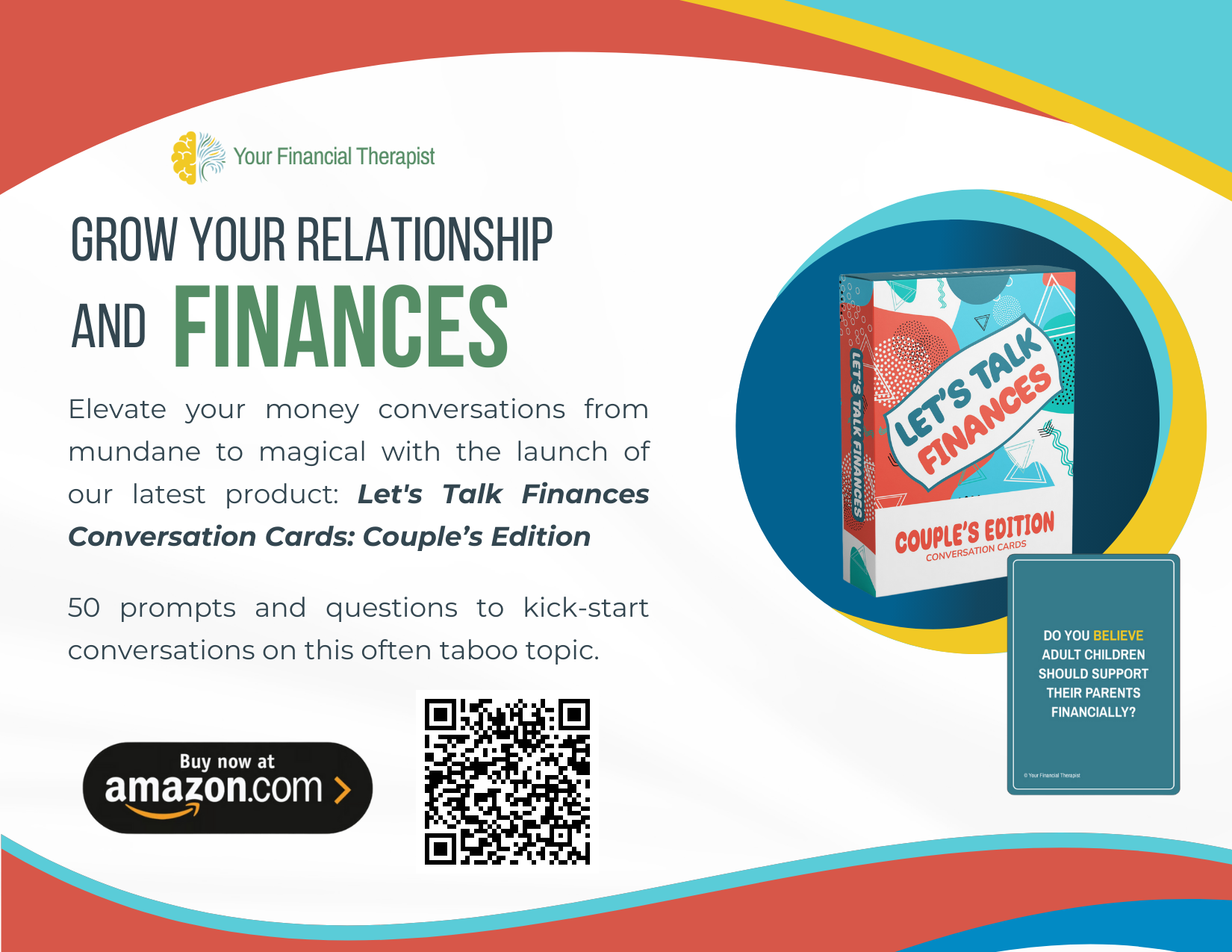
Let’s Talk Finances: Couples Edition Cards
If “so… let’s talk about money” makes you both freeze, the cards do the heavy lifting for you. The Let’s Talk Finances Couples Edition is a beautifully designed deck of conversation prompts created to help couples ease into money talks — without the spreadsheet energy.
Pour the wine, light a candle, draw a card, take turns answering. You will learn things about each other you didn’t know you didn’t know.
Best for: couples who want a low-pressure, playful, structured way to start. New relationships, long marriages, and everything in between.
→ Get the Couples Edition Cards on Amazon
Conversations with Your Financial Therapist (the Book)
If you are the kind of person who likes to understand something before you try it, start with the book. Conversations with Your Financial Therapist walks you through the real, human side of money — the stories, the patterns, the fears, the breakthroughs — with prompts and reflections you can do alone or together.
Read a chapter on the couch on a Sunday morning. Pass it to your partner. Talk about what hit you. Repeat.
Best for: readers, reflectors, journalers, and anyone who learns by thinking it through first. Great for couples who like to read together.
→ Get Conversations with Your Financial Therapist
A Final, Gentle Note
If you have read this far, here is what I want you to take away: the fact that you are even thinking about how to talk to your partner about money already means you care about your relationship and your life together. That is the work. That is the whole thing.
Start where you are. Pick up the cards. Pick up the book. You do not have to do this perfectly. You just have to start — and then, the beautiful part, keep going.
Your future selves are going to be so glad you did.
With warmth,
Erika · Your Financial Therapist
Need a little more support?
A few free 15-minute consultations open up in my calendar each month for couples who want to talk something through together. Find a time here.